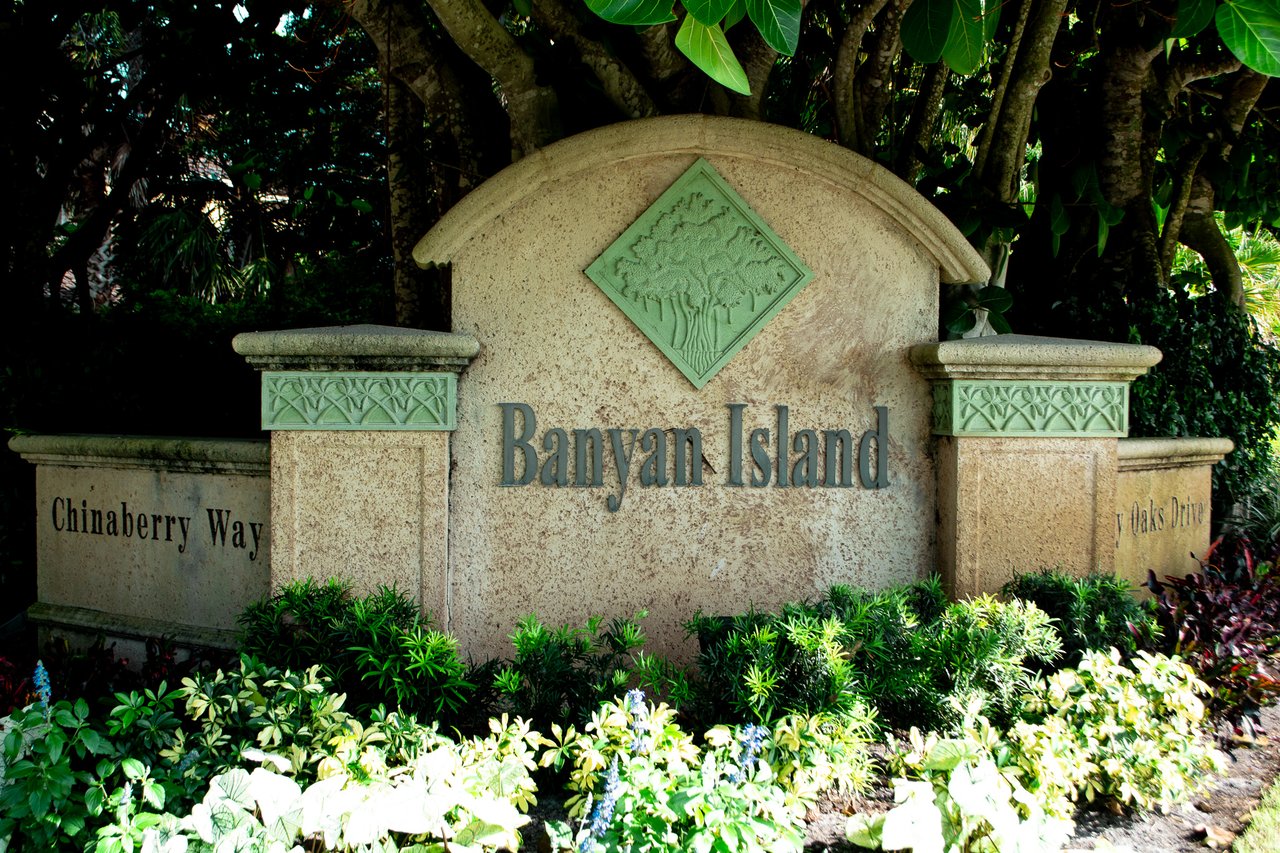
Twenty-six lots. That is all Banyan Island has ever had, and all it will ever have. The last one was finished in 2004, and since then the enclave has not added a single new address. For a buyer comparing Grey Oaks neighborhoods, that single fact changes the math more than any list price will.
Most Grey Oaks enclaves still carry some version of a normal resale market: homes trade, prices move, comparable sales pile up. Banyan Island doesn't work that way, because it can't. Every transaction there is really a decision about what to do with a structure that is now more than two decades old, on a lot that will never be joined by a twenty-seventh. Add a second fact that surprises most buyers, that Banyan Island doesn't have its own gate the way some of its Grey Oaks neighbors do, and the picture of what you're actually purchasing there starts to look different from the rest of the community.
A Neighborhood That Stopped Adding Inventory in 2004
Banyan Island sits along Chinaberry Way and Chinaberry Court, a small loop of oversized lots wrapped almost entirely by a lake. All but four of the 26 homes are considered lakefront, and most of the rest still get a golf course view across the water. Construction started in 2000 and closed out in 2004, with homes ranging from just over 3,400 square feet to just over 6,100 square feet.
That is the whole inventory. It was the whole inventory in 2004, and it is the whole inventory now. Banyan Island cannot annex a new parcel, cannot subdivide an existing one, and cannot expand past its lake boundary. Every other Grey Oaks enclave still under some form of development or infill has a pressure valve. Banyan Island doesn't.
That matters because it means the enclave's price history isn't really tracking appreciation on a stable product. It's tracking 26 individual bets on how well an early-2000s custom home has aged, and whether the next owner will renovate it, gut it, or replace it. The most recent public benchmark, the April 2024 sale of 1622 Chinaberry Way for $6,895,000, tells you what a well-positioned lakefront lot can command. It doesn't tell you what a dated interior on the same street is worth, because that's a different question entirely, and Banyan Island only ever has that question to answer.
The Renovate-or-Rebuild Clock Nobody Prices In
A home finished in 2000 is now old enough that its original kitchen, baths, and mechanical systems are candidates for a full gut, not a refresh. A home finished in 2004 isn't far behind it. Neither can be replaced with a new build on an empty lot next door, because there isn't one. So the choice facing a buyer in Banyan Island isn't the usual one of picking between an older home and a newer one elsewhere in the same neighborhood. It's whether to buy the aging structure as is, renovate it, or tear it down and start over on a lot you can never get back.
That last option is already showing up in how local listing records describe the enclave: with every homesite built out, the next wave of activity is expected to be teardown and rebuild rather than simple resale. In a neighborhood this small, one or two rebuilds can reset what "typical" looks like on the block for years, because there is no fourth or fifth comparable coming from a still-developing section of the community. Whatever gets built next effectively becomes the new baseline until the following rebuild resets it again.
That is a very different risk profile than buying into an enclave where new construction is still filling in vacant lots. There, a dated home is priced against a spectrum of ages. In Banyan Island, a dated home is priced against a clock, and that clock only moves in one direction.
The Gate You Assumed Was There
Grey Oaks as a whole is a gated community, and most buyers carry that assumption into every enclave inside it. Some of those enclaves add a second layer on top of the master gate. Estuary at Grey Oaks, for example, sits across the street from the main community and operates behind its own gated entry, an extension of Grey Oaks rather than a subdivision inside its perimeter.
Banyan Island doesn't have that second layer. It sits inside the Grey Oaks footprint but relies on the community's master gate rather than a private one of its own. For a buyer who has toured a separately gated enclave first and assumes every Grey Oaks address comes with the same security setup, that's a detail worth confirming before making an offer, not after.
None of this makes Banyan Island less private in practice. Its lots are large, its lake frontage limits through traffic, and its position within Grey Oaks still means access is controlled at the community entrance. But "gated" is not a single, uniform feature across every pocket of Grey Oaks, and Banyan Island is the clearest example of why that assumption doesn't travel.
Why the Timing Makes This Harder to Get Wrong
None of this would matter as much if Grey Oaks inventory were loose enough to give buyers room to wait and compare. It isn't. By May 2026, active listings in ZIP code 34105, home to Grey Oaks and Kensington, had fallen close to 40 percent year over year to roughly 191 homes on the market, according to a Naples golf real estate market analysis published in July 2026. On a 12-month trailing basis through February of that year, single-family homes in Grey Oaks were averaging around $4.66 million.
That scarcity applies across the whole community, but it lands hardest on an enclave that can only ever produce 26 chances to buy in. In a neighborhood with new inventory still being built, a tight market mostly means waiting a season for the right listing to surface. In Banyan Island, a tight market means the specific home you're evaluating, at whatever stage of its renovate-or-rebuild life cycle it happens to be in, may be the only one you get a real look at for a while. Getting that evaluation right the first time carries more weight than it would in a neighborhood with a deeper, still-growing bench of comparables.
Frequently Asked Questions
Is Banyan Island still accepting new construction? No. All 26 lots were built between 2000 and 2004, and there is no remaining vacant land within the enclave for new homes.
Does Banyan Island have its own security gate? It does not operate a separate gate the way some Grey Oaks enclaves do. It sits within the master-gated Grey Oaks community and relies on that entrance for access control.
What does the enclave's age mean for a buyer today? Most Banyan Island homes are now more than 20 years old. A purchase there is typically a decision about renovation scope or full rebuild potential rather than a choice between homes of varying ages, since no newer construction exists within the enclave.
If you are weighing a Banyan Island purchase against another Grey Oaks enclave, or trying to work out whether a specific home there is a renovation candidate or a rebuild, the Grey Oaks Real Estate Team can walk the property with you and lay out what that decision actually costs before you write an offer.