Pull up four different websites and search for Estuary at Grey Oaks, and you will get four different answers to what should be a simple question: what does a home here actually cost. One source puts the median sale price at $7.5 million, down nearly a quarter from a year earlier. Another shows active listings averaging close to $6 million. A third, describing the wider Grey Oaks community that includes Estuary, quotes a median anywhere from $3.7 million to $4.3 million depending on which page of the same site you land on. None of these numbers is wrong. All of them are describing a market too small to produce a stable answer.
This is the part buyers comparing Naples luxury enclaves rarely get told: in a community with a fixed, tiny inventory, the median price is not a measure of the market. It is a measure of whichever handful of homes happened to close.
Same 350 Acres, Four Numbers
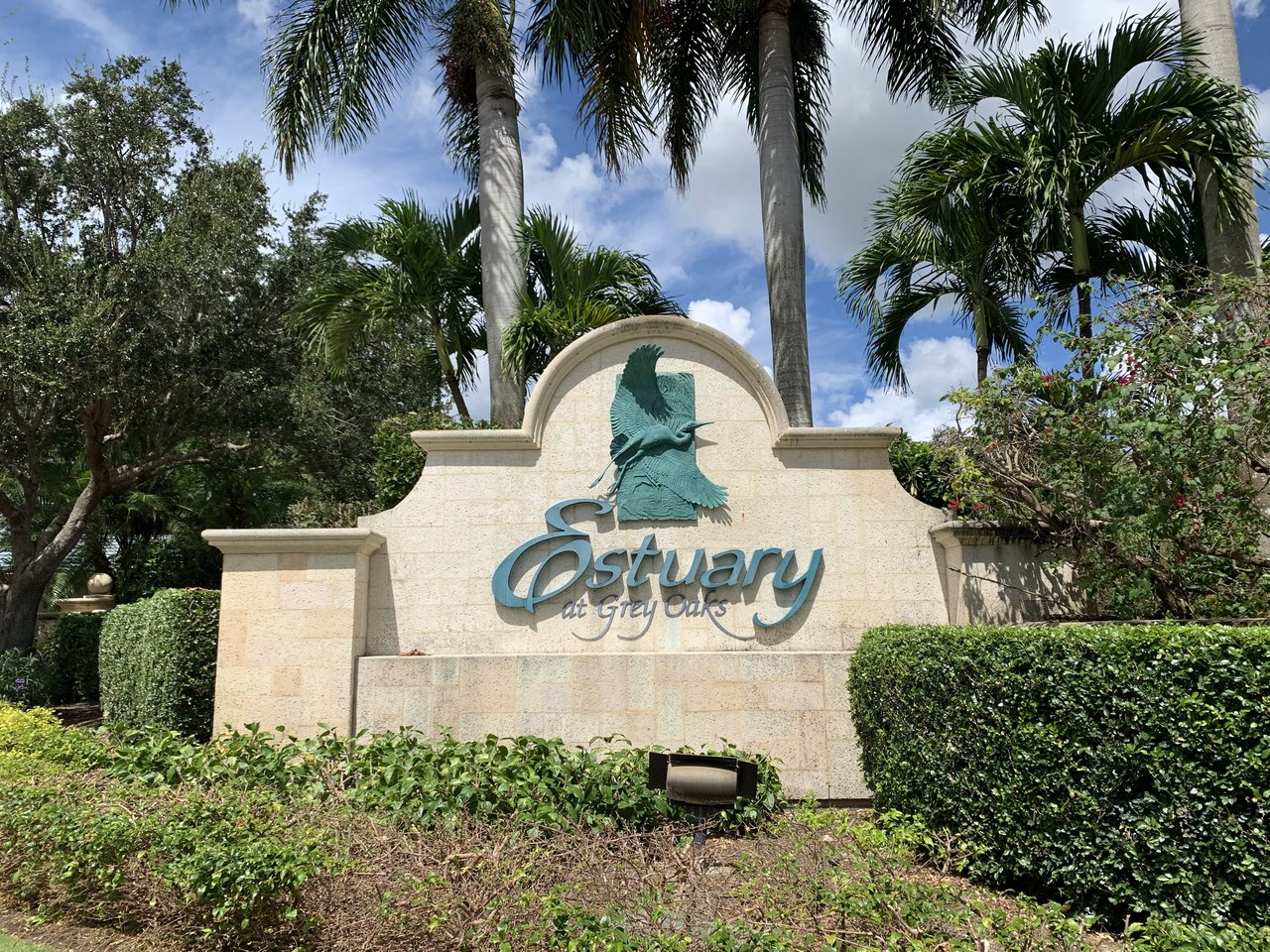
Estuary at Grey Oaks sits on 350 gated acres off Airport-Pulling Road, north of Golden Gate Parkway, built around an 18-hole course designed by Bob Cupp and its own lakefront clubhouse. It was planned from the start as a low-density counterpart to the wider Grey Oaks community, which spans roughly 900 acres and three golf courses. That planning choice, capping Estuary at somewhere in the neighborhood of 175 to 180 total homesites, is the reason the pricing data looks so unstable.
Here is what four sources reported for overlapping windows in 2026:
Source | Window | Figure |
|---|---|---|
Median sale price, Estuary at Grey Oaks | 3 months ending May 2026 | $7.5 million, down 23.7% year over year |
Average asking price, active Estuary listings | March 5, 2026 | $6.1 million across 6 active listings |
Average asking price, active Grey Oaks listings (community-wide) | May 29, 2026 | $5.0 million across 24 active listings |
Median sale price, Grey Oaks houses (trailing 12 months) | Spring 2026 | Reported between $3.7 million and $4.3 million depending on property-type filter |
These are not competing forecasts. They are snapshots of a market so thin that the specific mix of what traded hands, or what happened to be listed, moves the headline number more than any real shift in value could.
Why the Math Breaks in a 175-Home Enclave
A citywide median is stable because it is built on hundreds of transactions a month, so an outlier or two barely nudges the total. Estuary does not have that luxury. With well under 200 homes in existence and only a handful trading in any given quarter, one large estate closing alongside two smaller villas can swing a reported median by a million dollars or more without a single owner's home actually changing in value.
That is exactly what shows up in the numbers above. The $7.5 million figure and the $6.1 million figure describe the same small enclave within a few months of each other, and the gap between them is almost certainly explained by which properties happened to be in the sample, not by a sudden 20 percent shift in what Estuary real estate is worth. A buyer who treats either number as a forecast, rather than a snapshot of a thin sample, is drawing a conclusion the data cannot support.
This is worth sitting with if you are cross-shopping Estuary against other Naples enclaves using portal medians alone. The smaller the community, the less a single headline price tells you, and the more it matters to look at what is actually driving the number.
The Premium Isn't Exclusivity, It's Square Footage
Here is where the data gets genuinely interesting. Buyers often assume Estuary commands a higher price than the wider Grey Oaks community because it is more exclusive, more private, a step up in prestige. The per-square-foot numbers tell a different story.
As of spring 2026, active Estuary listings averaged $1,210 per square foot on homes running about 4,909 square feet. Active listings across the broader Grey Oaks community averaged $1,198 per square foot on homes closer to 4,054 square feet. Measured by the foot, the two communities are within roughly one percent of each other. The gap in total price, the reason Estuary's average asking price runs a million dollars or more above the community-wide figure, comes almost entirely from size, not from a location premium.
That size difference is not an accident. Estuary's 350 acres were divided among far fewer homesites than the rest of Grey Oaks, which means larger lots and larger houses by design, not because land here trades at a premium rate. A buyer deciding between a villa in Grey Oaks proper and an estate in Estuary should understand that the price difference reflects square footage more than it reflects prestige, which changes how you think about value if a smaller footprint suits your needs just as well.
Three Numbers Worth Trusting More Than the Median
Given how easily a headline median can mislead in a market this small, a few figures hold up better against the noise:
- Price per square foot. Because it adjusts for the size of whatever happens to sell, it moves less when the sample shifts from villa to estate and back.
- Days on market and list-to-sale ratio. Estuary listings have been selling in a median of around 48 days, at roughly 4 percent below asking price. That tells you something real about negotiating room regardless of which specific homes changed hands.
- Active listing count relative to total inventory. Six active listings in a community of 175 to 180 homes is a genuinely small number. It tells you how few opportunities exist at any given moment, which matters more for timing your search than a median that could swing on the next closing.
None of these numbers is exciting on its own. Together they give a buyer something closer to the truth than a single median ever could.
The Bigger Naples Picture
None of this scatter at the enclave level means the luxury segment is soft. The Naples Area Board of REALTORS' July 2026 market report, released in late August, showed the citywide single-family median climbing 12.9 percent year over year to $745,000, with the luxury tier recording ten sales above $10 million in July alone. Cash buyers have continued to dominate purchases above $2 million throughout the year, a pattern that shows up again and again in NABOR-sourced coverage of the Naples market.
Put that next to Estuary's noisy, contradictory medians and the picture becomes clearer. The wider luxury market is transacting briskly and holding value. What looks like volatility inside Estuary at Grey Oaks is a sampling artifact sitting on top of a structurally strong market, not evidence that the market underneath it is weakening.
Frequently Asked Questions
Does a lower reported median mean values in Estuary are falling? Not on its own. With only a handful of closings each quarter in a community of roughly 175 to 180 homes, the specific mix of what sold moves the median more than actual appreciation or depreciation does. Price per square foot holds up better as a quarter-to-quarter gauge.
How often does a home in Estuary actually come up for sale? Rarely, by design. Active listings sat around six this spring, a small fraction of the total enclave, which is part of why any single month's reported median is built on such a thin sample.
Is Estuary really priced higher than the rest of Grey Oaks? In total dollars, generally yes, mostly because Estuary homes run larger, averaging close to 850 more square feet than the wider community. Measured per square foot, the two are close enough that size, not location premium, explains most of the gap.
Numbers like these are exactly why a single portal snapshot rarely tells the full story in a community this specific. If you are weighing Estuary against the Estates or against Grey Oaks more broadly, and want someone who can walk you through what a listing's price per square foot and days on market actually mean for your negotiating position, the Grey Oaks Real Estate Team lives this market year round and can talk you through it in plain terms. Contact Us when you are ready to look past the headline number.